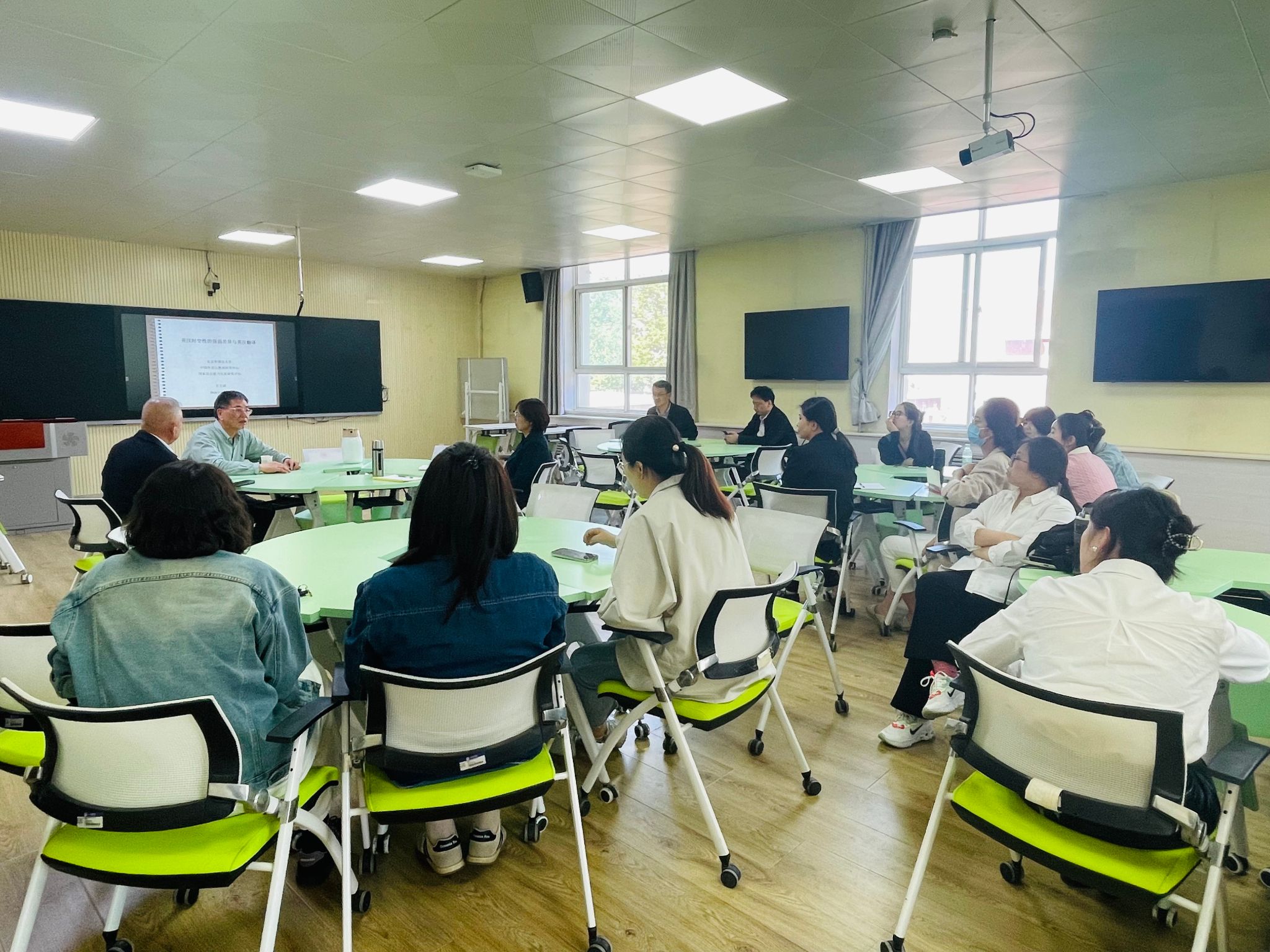
On the afternoon of April 17, the 85th academic lecture of the “Zhongnan Culture Translation Forum” Lecture Series was successfully held in Classroom 2401, Building 2, West Campus. Professor Wang Wenbin from Beijing Foreign Studies University was invited as the keynote speaker to deliver an academic talk entitled “Temporality-Spatiality Strength Contrast in English and Chinese and Its Implications for Translation.” Professor Yuan Xiaolu, Dean of the School of English Studies at Xi’an Fanyi University, along with faculty members and students from the School, attended the lecture, which was presided over by Dean Yuan Xiaolu.
During the lecture, Professor Wang Wenbin started from the essential differences between English and Chinese, deeply analyzing the distinct characteristics of the two languages in expressing time and space. He pointed out that English tends to emphasize the expression of tense and mood, places importance on predicate verbs in sentences, and highlights the cohesion between subject and predicate, forming a time-driven linear structure with strong syntactic and logical features. In contrast, Chinese focuses on the expression of objects and events, arranges images or events in sentences, and emphasizes the logical relationship between subject-predicate structures and things, thereby presenting spatiality, zero-orderliness, and discreteness. Professor Wang emphasized that the key to English-Chinese translation lies in grasping these linguistic features and flexibly converting between them to achieve smooth communication between the “source language” and the “target language.”
Regarding the relationship between artificial intelligence and language education, Professor Wang offered unique insights. He pointed out that there is an essential difference between teaching and education: where there is education, there must be teaching, but teaching does not necessarily entail education. Although artificial intelligence can accomplish many tasks at the teaching level, it cannot replace true education. In the era of artificial intelligence, human-machine collaboration must be realized. He stressed that every teacher's classroom should prioritize artistry over technology. AI features large language models, high computing power, and patterning; however, language expression has national boundaries, and mother tongue competence always remains the foundation of translation and cross-cultural understanding. Professor Wang also vividly illustrated the significance of learning a foreign language with the saying, “With a foreign language, the world is before you; without a foreign language, the world is just what lies before your eyes.”
Professor Wang concluded by noting that Chinese sentences prefer brevity over length, whereas English sentences prefer length over brevity. In translation, one should respect the respective language habits to enhance the naturalness and readability of the translated text. The lecture was substantial, combining theoretical depth with practical pedagogical relevance, providing valuable insights for the faculty and students present in understanding the differences between English and Chinese and in improving their translation practice.
This lecture has infused new dimensions of thought into the study of literary translation and cross-cultural teaching, further advancing the exploration of the integration of academic dissemination and teaching practice at the Zhongnan Culture Translation Forum.
Author: Wang Yawen

