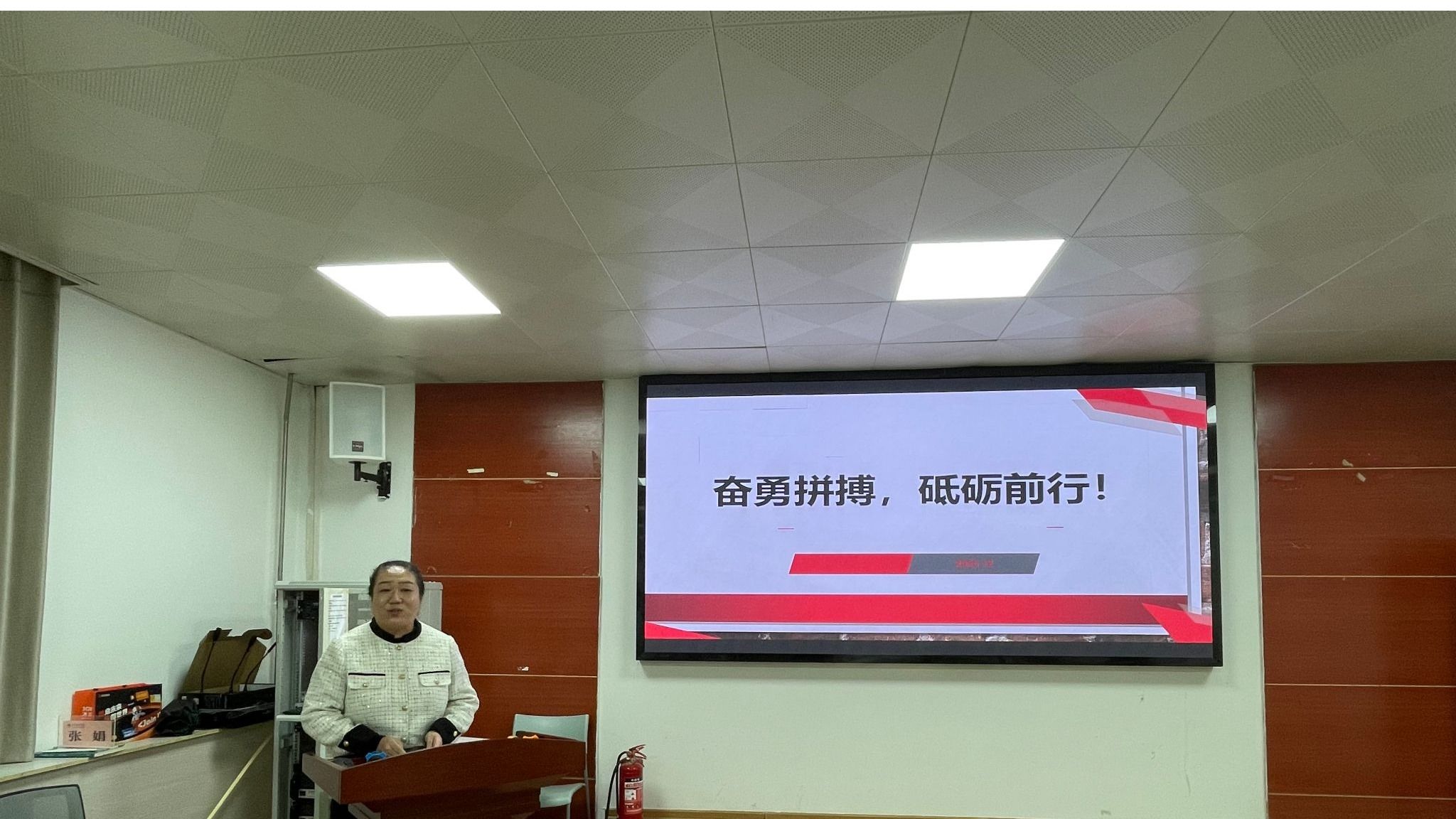
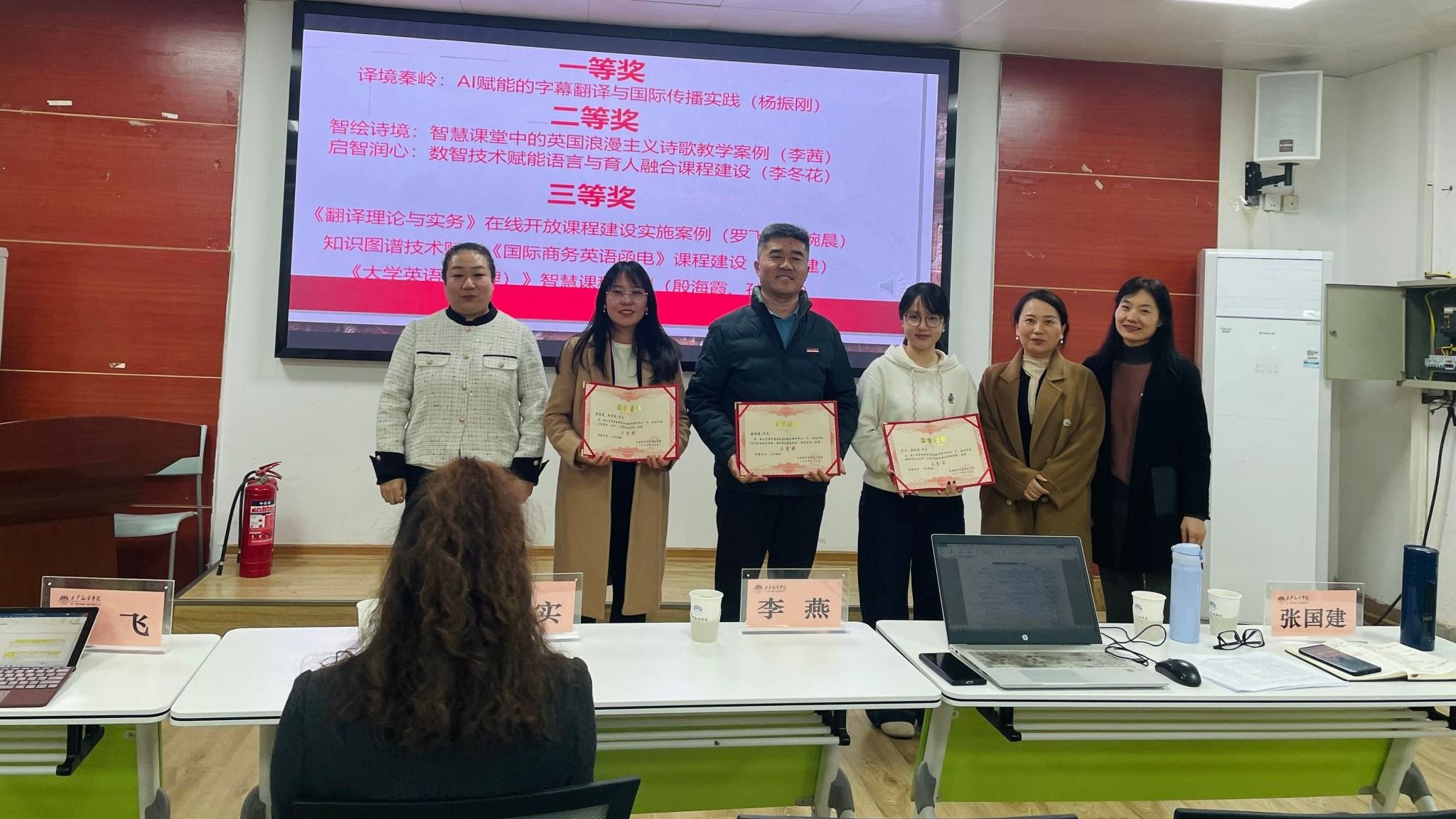
To further advance course development within the division, promote teaching innovation, and facilitate experience sharing, the SELC successfully held the “2025 Smart Course Development Experience Sharing Session” in Room 2407 on the afternoon of December 10, 2025. In attendance were Jian Shi, Assistant to the Dean of the School of English Studies; Luo Fei, Head of the Translation Department; Zhang Guojian, Head of the Business English Department; and Wang Yinghui, Head of the English Department. The session was chaired by Zhang Juan, Director of the Public English Teaching Center. Focusing on smart teaching and curriculum reform, the event invited three faculty members—Li Qian, Li Ran, and Yang Zhengang—to deliver thematic presentations. All teachers of the school engaged in in-depth discussions and exchanges based on the shared content.
At the opening of the session, Jian Shi, Assistant to the Dean, delivered a welcoming address. She remarked, “Smart course development is a mission entrusted to us in the new era. It is not about following trends, but about serving our students. We hope this sharing session will spark more innovative ideas and drive the transformation of the teaching paradigm from ‘knowledge transmission’ to ‘competency cultivation.’”
Following this, Li Qian presented on the topic “Wisdom-Painted Poetic Realm: English Poetry Teaching in the Smart Classroom,” systematically introducing innovative applications of artificial intelligence technology in poetry instruction. She particularly emphasized the evolving role of teachers in the age of AI, proposing a “Human-Machine Collaborative Intelligent Dual-Teacher Model.” She pointed out that teachers should become instructional designers, technology integrators, and emotional guides, achieving an organic integration of technology and humanities education.
Li Ran, focusing on “Digital Intelligence Technology Empowering the Integration of Language and Ethical Education in Course Development,” provided a detailed report on the progress of the digital intelligence course “Advanced English.” She highlighted the functions and outcomes of the smart teaching platform and intelligent assessment system, and outlined future development plans for the course in terms of resource integration and evaluation system optimization. This reflected the distinct features of technology integration and systematic advancement in course development.
Yang Zhengang shared insights on the theme “Translating the Qinling Realm: AI-Empowered Subtitle Translation and International Communication Practice,” presenting the instructional design and practical outcomes of translation courses. He elaborated on the teaching process: “Theme Introduction – Subtitle Transcription – Translation and Post-Editing – Subtitle Optimization and Dissemination.” Using specific teaching cases, he explained how to integrate the cultural theme of the Qinling Mountains into translation practice.
The sharing session was substantial in content and diverse in perspective, combining theoretical depth with practical relevance. It provided faculty with valuable insights into course development and teaching methodologies. The participating teachers unanimously expressed that they would take this session as an opportunity to further deepen teaching reforms, promote the deep integration of information technology and foreign language education, and jointly contribute to advancing the school’s first-class course development and the cultivation of high-quality foreign language talent to new heights.