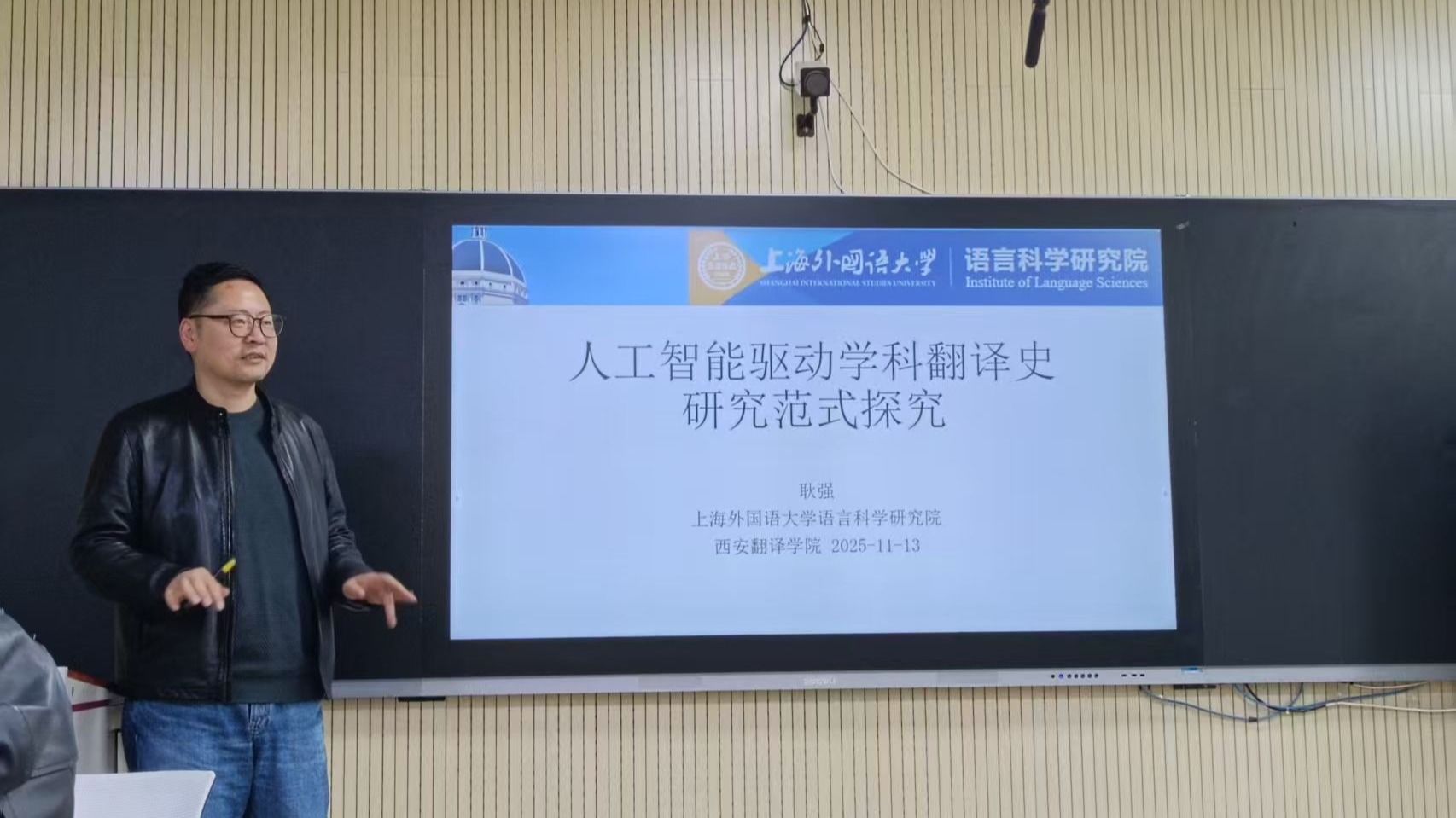
On the afternoon of November 13, 2025, the 77th session of the “Zhongnan Cultural Translation Forum” was successfully held in Classroom 2401, Building 2, West Campus. The lecture featured Professor Geng Qiang, a dedicated researcher at the Institute of Language Sciences of Shanghai International Studies University and a doctoral supervisor, who delivered a thematic report titled “Theories and Methods of AI-Driven Translation History Research”. The event was attended by Professor Yuan Xiaolu, Dean of the School of English Language and Culture, along with Vice Deans Professor Zhang Rui and Professor Li Yan. The lecture was hosted by Vice Dean Professor Zhang Rui.
Professor Geng Qiang, who also serves as Secretary-General of the Translation Studies Committee of the Shanghai Foreign Literature Association and Council Member of the Chinese Comparative Literature Translation Studies Association, began the lecture by delving into the macro-level context of the “big data shift” currently underway in the humanities and social sciences in the digital era. He emphasized that this shift represents not only an upgrade in research instruments but also a profound transformation in research paradigms and conceptual frameworks, opening new pathways for translation history research.
When elaborating on the new paradigm of AI-driven translation history research, Professor Geng systematically compared the fundamental differences between traditional research and data-driven research. He highlighted that the new paradigm, through in-depth mining of structured data, can reveal macro-level patterns and complex connections that traditional methods struggle to detect, thereby overcoming the limitations of “information silos”.
Addressing research methods and data issues, Professor Geng provided a detailed analysis of the types and characteristics of data in translation history research, pointing out the current challenges in dataset construction, such as small scale, lack of standardized formats, and the absence of specialized databases. He systematically introduced three approaches to dataset construction and objectively analyzed their respective advantages and disadvantages. Regarding the research process, he emphasized that human researchers should act as “guides”, engaging in in-depth dialogue with AI while paying attention to relevant ethical issues in scientific research.
In conclusion, Professor Geng outlined the future prospects of integrating artificial intelligence with translation history research. He proposed that efforts should focus on digitizing historical translation materials and building big data infrastructure, while adhering to a mixed-methods approach that combines qualitative and quantitative research. Researchers should not only revisit traditional questions with new methods but also courageously explore new frontiers. He stressed the importance of strengthening ethical norms throughout the research process, ensuring transparency, and consistently maintaining the critical leading role of human researchers.
The lecture, with its systematic content and logical progression, clearly outlined the complete roadmap and development prospects of AI-driven translation history research. It effectively ignited strong interest among faculty members of the School of English Language and Culture in interdisciplinary innovative research, achieving complete success.
Correspondent: Gou Xiaoru

