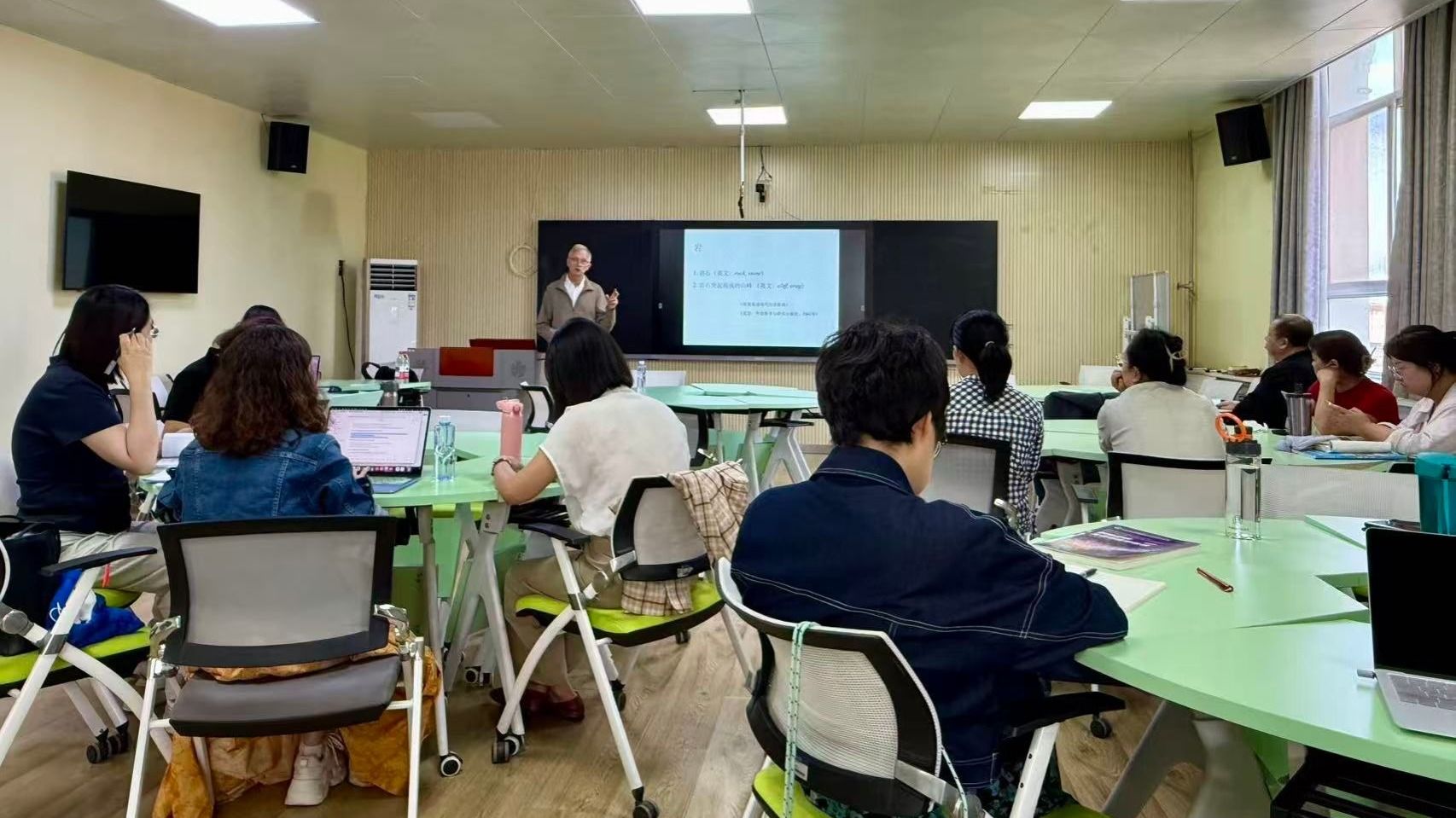
To broaden faculty members’ academic horizons, deepen their understanding of translating Chinese classics, and promote the international dissemination of outstanding traditional Chinese culture, the 91st Zhongnan Cultural Translation Forum was held on the afternoon of September 17, 2026, in Room 2401 of Building 2 on the West Campus.
The lecture, titled “The Mutual Support of Literary Translation and Cultural Studies: The English Translation of The Travels of Xu Xiake as a Case Study,” was delivered by Allan Barr (Bai Yaren), Professor Emeritus in the Department of Asian Languages and Literatures at Pomona College. Professor Barr gave the entire lecture in Chinese, with several faculty members from the School of English in attendance.
Before the lecture, Dean Zhang Rui introduced Professor Barr, warmly welcoming him and expressing sincere appreciation for his academic contribution. Dean Zhang also briefly outlined the background and purpose of the forum.
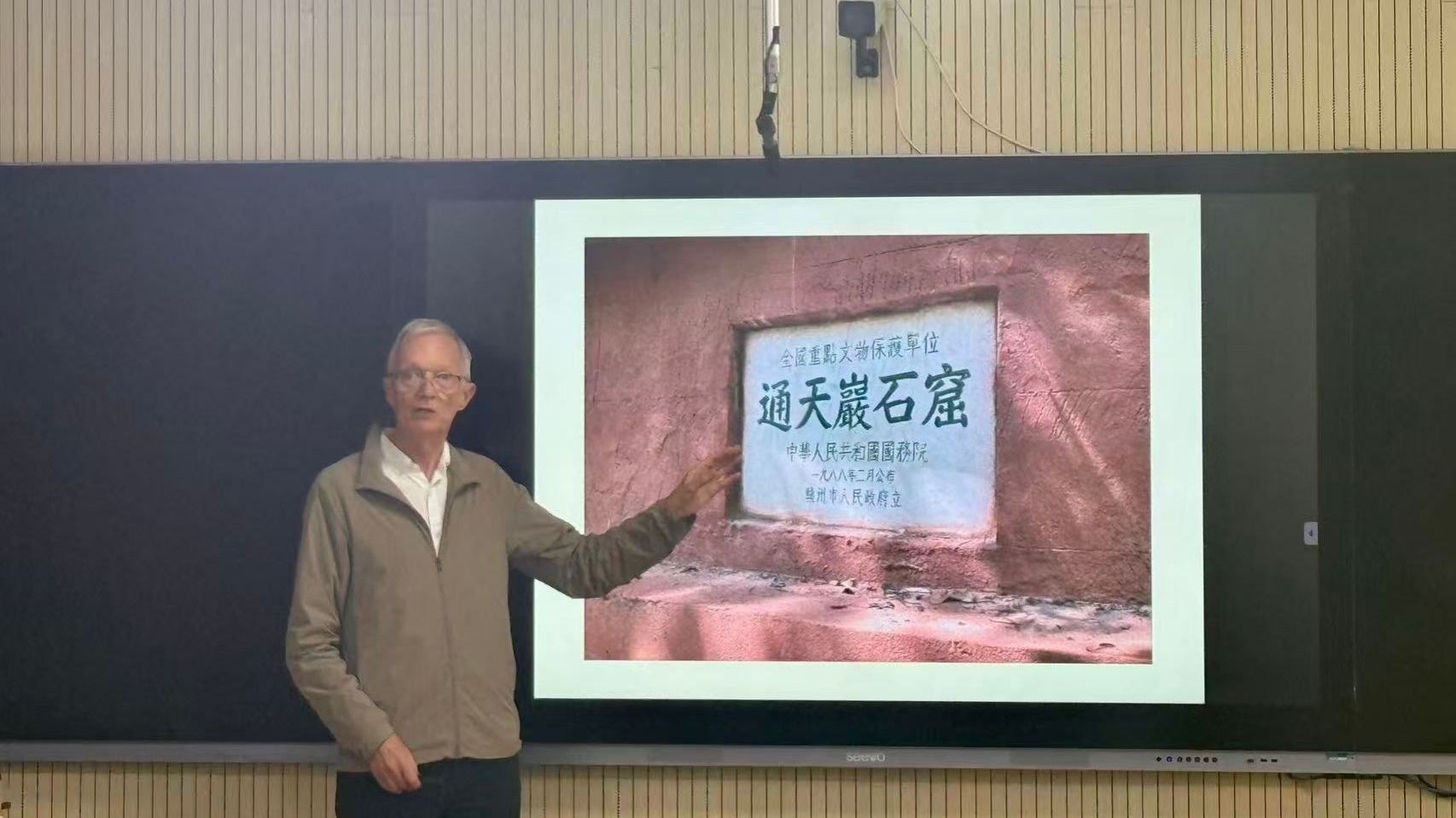
Using the English translation of The Travels of Xu Xiake as a case study, Professor Barr examined the mutually reinforcing relationship between literary translation and cultural studies. He began with the dual meanings of the classical Chinese character yan (岩). In modern Chinese, yan commonly refers to rocks or cliffs; in ancient texts, however, it could also denote rock shelters or sheltered places beneath overhanging rocks—an important meaning that is often overlooked by contemporary translators.
Drawing on such historical works as Yuan Jie’s Inscription and Preface for Yanghua Rock, Cheng Shiyong’s Fengshi Leibian, and Xu Fang’s Passing Tiger Rock, Professor Barr distinguished between the concepts of “rock” and “cave.” He traced traditional literati attitudes toward the two terms and analyzed Xu Xiake’s distinctive aesthetic appreciation of rocky landscapes and caves. The lecture also incorporated perspectives from modern geology, comparing scientific definitions of caves and surrounding rock formations with premodern understandings. By examining the interchangeable use of “rock” and “cave” in ancient travel writings and local gazetteers, Professor Barr illustrated how the meaning of yan gradually evolved from a term with dual meanings to one with a more singular sense.
Professor Barr emphasized that translating classical texts is far more than a matter of converting words from one language to another. Without careful philological research and a clear understanding of historical cultural concepts, translators may misinterpret a text and diminish its rich cultural significance. Literary translation is grounded in rigorous cultural research, while cultural research relies on translation for international dissemination; the two are inseparable and mutually supportive.
During the discussion session, participating faculty members raised questions about the challenges of translating Chinese classics, the interpretation of classical Chinese vocabulary, and the overseas dissemination of classical literature. Professor Barr responded in detail in Chinese, fostering a lively academic exchange. His fluent Chinese-language presentation greatly inspired the participants and further underscored the central role of textual research and cultural studies in the translation of Chinese classics.
Tingyue ZHANG

